Acamapichtli at a Glance
- Full Name
- Acamapichtli (Nahuatl: "Handful of Reeds"); also styled Acamapichtli Ometochtli.
- Title
- First tlatoani ("he who speaks") of Tenochtitlan, ancestor of the later Huey Tlatoque.
- Reign
- c. 1376–1395 (about nineteen years).
- Ancestry
- Son of a Mexican leader and a princess of Culhuacan — the prestigious, "cultured" descendants of the Toltecs.
- Significance
- Began the dynastic marriage strategy that legitimised Mexica rule and laid the political foundations of the empire.
- Successor
- Huitzilihuitl, his son.
- Context
- Ruled while the Mexica were still vassals of the powerful Tepanec state of Azcapotzalco.
I. Overview
Acamapichtli is traditionally counted as the first tlatoani of Tenochtitlan, reigning from about 1376 to 1395. He is the head of the ancestral line from which every later Aztec emperor descended. Before him the Mexica had been led by elected war captains and tribal patrons, not by a formal hereditary monarch. The selection of Acamapichtli therefore marks the moment the Mexica began to build a royal state — a crucial turning point on the road to the Aztec Empire that his descendants would command (World History Encyclopedia, "Aztec Civilization").
His reign is sometimes described as modest because the Mexica were still junior partners in a valley dominated by Azcapotzalco. Yet the importance of Acamapichtli lies precisely in the foundations he set: he supplied the new dynasty with Culhua legitimacy, married into noble families to bind the city together, and began the tribute and public-works traditions that would grow into imperial statecraft.
II. Origins: A Half-Culhua Prince
The Culhua people of Culhuacan, on the southern shore of the great lake, were regarded throughout the Valley of Mexico as the heirs of the glorious old Toltec culture. Marrying into their nobility was the surest way for an upstart people to claim a share of that prestige. The Mexica had spent generations trying to attach themselves to Culhua lineage, and Acamapichtli embodied that strategy: he was born of a Mexican father and a Culhua princess (WHE, "Aztec Civilization").
According to the traditional accounts recorded in early colonial sources, the Mexica nobles — after the city had been founded and needed a permanent ruler who could both lead them and lend them dignity — searched for a candidate of suitable blood. Acamapichtli, living at Culhuacan, was selected and brought back to Tenochtitlan. In the standard version of the story he was already married, and at his new city he took a series of noble wives so that the principal Mexica families could each claim a direct connection to the ruling house.
III. A Reign of Foundations
The nineteen years of Acamapichtli's rule were less a time of conquest than of consolidation. The coffers of Tenochtitlan could not yet support an aggressive army, and the Mexica remained tribute-paying vassals of the Tepanec ruler of Azcapotzalco, then the strongest power in the valley. Nonetheless, the new state took shape under him:
- Dynasty. He established the hereditary principle — that the city's ruler passed the title to his descendants — replacing the earlier rotating speaker-selection.
- Unification by marriage. He took multiple brides drawn from the leading Mexica wards, binding the different clans of the city to the throne.
- Culhua legitimacy. His very blood granted the Mexica a claim to the Toltec inheritance and to ritual standing among the older valley states.
- Tribute and works. Under the dominion of Azcapotzalco the city delivered fixed tribute — including the celebrated woven mantles that became a form of "currency" — an obligation that paradoxically trained the Mexica in the administrative techniques of empire.
Documentation of his individual military exploits is thin compared with later emperors, and many details are embedded in legend. What is certain is that when the energetic Huitzilihuitl succeeded him, Tenochtitlan was a functioning monarchy with real political weight — a city, a dynasty, and a strategy in place (WHE).
IV. Timeline Study Cards
Click each card to flip it and read the 200–500 word story of that moment.
Selection of Acamapichtli
After decades of wandering and the founding of their island city, the Mexica decided they needed a permanent ruler. Up to this point leadership had rested with a council of senior warriors and priests; there was no single king, and no hereditary line. The city's leading citizens therefore went in search of a noble who could give the new state both a leader and a claim to lineage.
They looked to Culhuacan, the old city on the southern shore of the lake that was held to inherit the prestige of the Toltecs. There they found Acamapichtli, the son of a Mexican and a Culhua princess. He was invited — in some tellings brought back — to Tenochtitlan and installed as its first tlatoani.
The choice was doubly wise. On the one hand it gave the Mexica a monarch around whom a court, a palace and a bureaucracy could form. On the other hand his Culhua mother connected the newcomers to the most respected civilisation of the region, letting them borrow its cultural and ritual standing. To widen the dynasty's support, tradition holds that the new king then married into the many noble houses of the city, so that each great clan could claim kinship with the throne. This act matters enormously for Aztec history: every later emperor, from Huitzilihuitl to Cuauhtémoc, traced his authority back to this single succession. The election of Acamapichtli is therefore the true birth of the Aztec royal house.
Founding the Imperial Line
The details of Acamapichtli's routine rule are thinly recorded because the Mexica were still a minor, tribute-paying people. Their overlord was the Tepanec king of Azcapotzalco, far stronger than anything Tenochtitlan could field. The new city therefore survived by delivering the tribute demanded of it — textiles, produce and labour — while quietly building its own institutions.
Yet it is precisely this quieter work that gives the reign its importance. Acamapichtli fixed the principle that power descended from father to son, ending the old practice of rotating or elected war-leaders. He took wives from the city's wards so that each calpulli felt bound to the royal house, creating a nobility loyal to the throne rather than to its own clan alone. And by bringing his Culhua heritage to the fore, he gave the Mexica a respected past to build on.
Historians see these seemingly small choices as the framework on which the whole later empire rested. Without a stable, legitimate, inheritable throne, the ambitious conquests of Motecuhzoma I, Axayacatl and Ahuitzotl would have been impossible. Acamapichtli, the "Handful of Reeds," handed his successors not a great army but something more durable: a monarchy with a name, a lineage and a purpose.
V. Tenochtitlan in Acamapichtli's Day
To understand Acamapichtli, one must picture the Tenochtitlan he ruled: a small but ambitious island town on the western edge of Lake Texcoco, surrounded by water, reed-beds and chinampa gardens, and overlooked by the smoking volcanoes of the Valley of Mexico. It was a humble place compared with the great capitals that would follow, but it was already strategically blessed — a defensible island home with rich lake resources and room to grow.
The people of this community were the Mexica, still living with the memory of their long migration from the north and their struggles to find a home among the valley's older, more powerful states. Their city was organised into wards, each with its own identity and patronage; their economy mixed farming, fishing and the collection of lake salt with burgeoning craft and trade. Priests served the patron god Huitzilopochtli, whose temple anchored the growing ceremonial heart of the town.
Into this setting came Acamapichtli, and with him came a new idea: that the Mexica should have a single hereditary lord, a tlatoani, to bind their clans together and represent them before the valley's great powers. The transformation was gradual under his guidance, but its direction was set. The Tenochtitlan of his old age, with its palace, its settled succession and its confident court, was already recognisably the seed of the imperial capital that his descendants would raise to glory.
VI. Daily Life, Culture & the Seeds of Empire
Life in Acamapichtli's Tenochtitlan was agricultural and communal at its core. Most Mexica were farmers and fisherfolk, working the chinampas and the lake, feeding their families maize, beans, squash, amaranth, fish and ducks. The extended family that shared a plot and a household formed the basic social unit, bound together by the calpulli ward that supplied labour, tribute and warriors and honoured its own patron deity.
Culture in this era was oral and ceremonial. Songs, dances and stories passed down the memory of the migration and the deeds of heroes; the priests maintained the calendar and read the omens that guided the community's rites. There was as yet little of the dazzling art that would later cover the empire, but the foundations of Mexica identity — devotion to Huitzilopochtli, pride in a chosen destiny, and a martial, disciplined spirit — were already firmly in place.
It was upon these foundations that Acamapichtli set his royal house. His reign did not create the empire overnight, but it gave the Mexica something almost as precious: an institution — the hereditary throne — around which all their later ambition could organise. Every palace build, every festival, every law laid down in his time was a brick in the edifice of empire, and the credit for that patient foundation work belongs, above all, to the first king.
VII. Legacy
Acamapichtli is remembered less as a conqueror than as a founder. He gave the Mexica their first hereditary monarchy, a Culhua-rooted genealogy, and an assertive sense of destiny. Every Huey Tlatoani who followed, from the empire-builder Motecuhzoma I to the last defender Cuauhtémoc, wore a crown that he had placed, in effect, upon the house of Tenochtitlan.
Modern scholarship stresses that the Aztec empire was not inevitable. It was built, step by step, by rulers who could count on the legitimacy Acamapichtli secured. His modest reign of foundations is thus a necessary prologue to the dazzling conquests that followed it.
VIII. Image Gallery


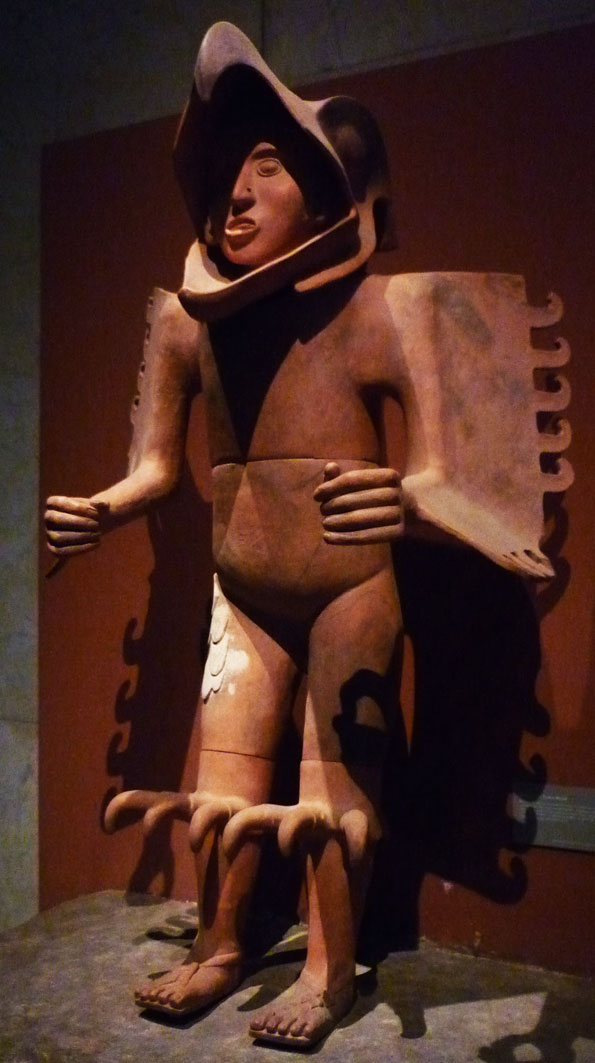
IX. Watch & Study
Video: "9. The Aztecs — A Clash of Worlds (Part 1 of 2)", Fall of Civilizations (public educational documentary). This long-form documentary places early rulers like Acamapichtli in the full sweep of Aztec imperial history.
X. Sources & Further Reading
This biography is written in original prose from established scholarly and reference sources; no source text has been copied. Direct links are given to every principal source.
Primary sources used for this entry
- World History Encyclopedia — "Aztec Civilization" (Mark Cartwright).
https://www.worldhistory.org/Aztec_Civilization/ - World History Encyclopedia — "Tenochtitlan".
https://www.worldhistory.org/Tenochtitlan/ - World History Encyclopedia — "Templo Mayor".
https://www.worldhistory.org/Templo_Mayor/ - Encyclopaedia Britannica — "Acamapichtli".
https://www.britannica.com/biography/Acamapichtli - Wikimedia Commons — freely-licensed images.
https://commons.wikimedia.org/
He who rules well, rules little and long; but he who rules by fear will be obeyed only while men are afraid.— a saying associated with the wisdom tradition of the Nahua rulers